UAE Audit & Compliance Services You Can Trust

Annual Audit Requirements in the Construction & Real Estate Sector in the UAE
Gupta Group International
4/7/20263 min read


Annual Audit Requirements in the Construction & Real Estate Sector in the UAE
Legal Framework Governing Audits in the UAE
Audit requirements in the UAE are primarily governed by:
Federal Decree-Law No. 32 of 2021 (Commercial Companies Law)
Corporate Tax regulations (introduced in 2023)
Free Zone Authority rules (where applicable)
Industry-specific regulators (e.g., real estate authorities)
Under the Commercial Companies Law, most mainland companies are required to prepare audited financial statements annually and appoint a licensed auditor.
Additionally, audited financial statements are mandatory for certain entities subject to corporate tax thresholds and qualifying free zone entities.
Annual Statutory Audit Requirements
For construction and real estate companies, the statutory audit typically includes:
Preparation of financial statements (Balance Sheet, P&L, Cash Flow)
Compliance with IFRS (International Financial Reporting Standards)
Independent audit by a licensed UAE auditor
Submission within prescribed timelines (often within 90 days of year-end)
Annual audits are not just a legal obligation but also essential for license renewal, banking compliance, and investor reporting.
Industry-Specific Audit Requirements
A. Construction Sector Construction companies face additional audit layers due to project complexity:
Project-Based Audits
Required for large-scale or government projects
Often mandated by developers, lenders, or authorities
Dubai Municipality (DM) Classification Audit
Ensures contractor eligibility and grading
Evaluates financial strength, liquidity, and project capacity
Revenue Recognition (IFRS 15)
Critical for long-term contracts
Requires accurate recognition based on project progress
Key Audit Focus Areas
Contract accounting
Retention money
Subcontractor payments
Cost allocation and budgeting
These requirements ensure transparency in high-value, multi-year infrastructure projects.
B. Real Estate Sector
Real estate companies and developers are subject to strict compliance and reporting standards:
Regulatory Audits
Mandatory audits for developers (e.g., escrow account compliance)
Oversight by real estate regulatory authorities
Escrow Account Audits
Ensures funds collected from buyers are used appropriately
Mandatory for off-plan property developments
Financial Statement Audits
Required annually for developers, brokers, and property managers
Internal Audit Requirements
Evaluation of internal controls, risk management, and governance
Essential due to high transaction volumes and investor involvement
Internal audits play a key role in maintaining transparency, risk control, and investor confidence in the sector.
Free Zone vs Mainland Audit Requirements
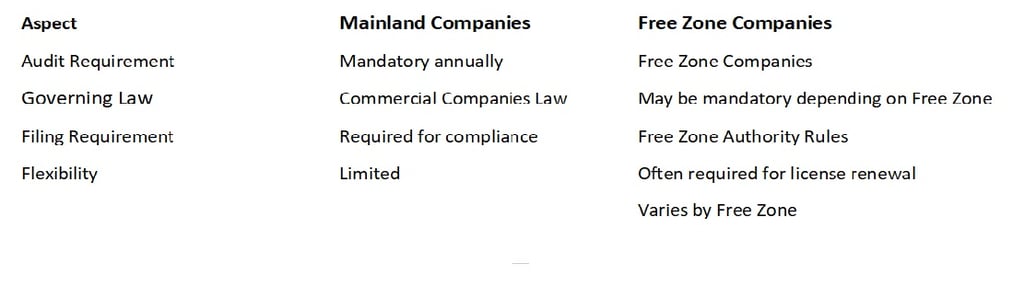
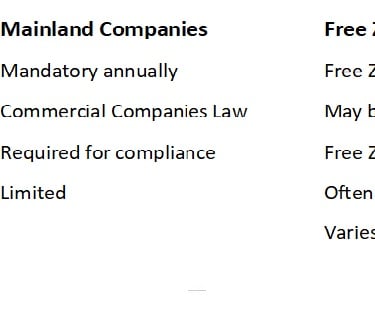
Even when not legally mandatory, many free zone companies conduct audits for banking, tax, and investor requirements.
Corporate Tax and Audit Impact
With the introduction of UAE Corporate Tax:
Businesses exceeding AED 50 million revenue must maintain audited financial statements
Qualifying free zone entities must also comply
Audits now play a key role in tax compliance and reporting accuracy
This has significantly increased the importance of maintaining audit-ready financial records.
Key Documents Required for Annual Audit
Construction and real estate companies should maintain:
Financial statements and general ledger
Contracts and project agreements
Bank statements and reconciliations
Invoices and payment records
Fixed asset register
VAT and corporate tax filings
Maintaining accurate documentation is essential to ensure smooth and timely audit completion.
Importance of Audits in Construction & Real Estate
Annual audits offer several benefits:
Ensure regulatory compliance
Improve financial transparency
Strengthen investor confidence
Support loan approvals and financing
Detect fraud and operational inefficiencies
In high-value sectors like construction and real estate, audits are not just compliance tools—they are strategic instruments for growth and credibility.
Conclusion
The construction and real estate sectors in the UAE operate in a highly regulated and financially complex environment, making annual audits a critical necessity.
From statutory audits to project-specific and regulatory audits, businesses must stay compliant with evolving laws and standards.
Partnering with a professional audit firm ensures that your company remains compliant, efficient, and ready for sustainable growth.
How Gupta Accountants Can Help
At Gupta Accountants, we specialize in:
Statutory audits for UAE companies
Construction project audits
Real estate and developer audits
Internal audit and risk advisory
Corporate tax compliance
Contact Us
📞 +971 4 396 7982
Useful Links
Services | Insights | Contact
© 2011–2026 Gupta Accountants LLC
Dubai, United Arab Emirates

